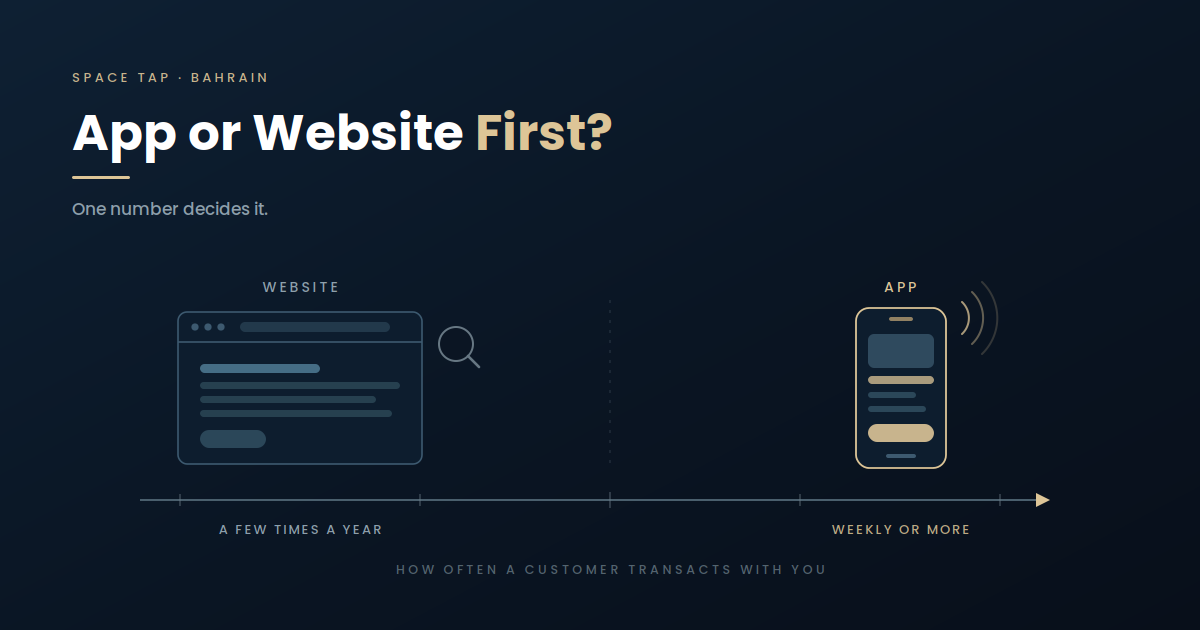
Everything follows from frequency. Not revenue, not sector, not what your competitor did.
An app lives on a phone's home screen. That is the entire advantage — you occupy real estate on a device your customer looks at a hundred times a day, and you can send a push notification without paying anyone for the privilege. That advantage only compounds if the customer opens it regularly. An icon that goes untouched for eleven weeks gets deleted, and you paid for a customer relationship that expired.
A website has the opposite profile. Nobody keeps it on their home screen, but it is findable. Someone in Riffa typing "gold jewellery Bahrain" into Google at eleven at night finds a website. They do not find an app — nobody searches the App Store for a shop they have never heard of.
So the question becomes concrete:
- A customer transacts with you weekly or more. Coffee, food delivery, groceries, fuel, salon bookings, gym access. An app can earn its place, because it will be opened often enough to build habit.
- A customer transacts with you a few times a year. Jewellery, furniture, insurance, dental work, real estate, professional services. A website does the job better and costs less to keep alive.
- A customer transacts once, or once a decade. Contracting, legal, one-off installations. A website, and the app conversation should not be happening yet.
We built the Costa Coffee Club app in Bahrain for a business where the same customer buys several times a week. Loyalty stamps, a QR code at the counter, a free drink at five — that mechanic only functions with repeat frequency. We built Kooheji Jewellery as a website, because a jewellery house sells to a customer who is researching, comparing, and visiting a showroom, perhaps twice in a decade. Both were the right call. Reversing them would have wasted both budgets.
The discovery problem nobody raises in the kickoff meeting
This is the part that gets skipped, and it is the part that decides whether the investment returns anything.
An app has no discovery channel of its own. The App Store and Google Play are search engines for apps people already know the name of. If your customer does not already know you exist, the app cannot introduce you — you have to introduce the app, through advertising, in-store signage, staff prompting at the till, or a website that tells people it exists.
Which means an app is not a customer acquisition tool. It is a customer retention tool. It makes the customers you already have more valuable, more frequent, and harder to poach. That is a real and significant return — it is just not the return most people think they are buying.
A website is the opposite. It is a discovery asset that compounds. Every service page, every location page, every properly structured piece of content is another entry point from Google, and increasingly from AI assistants that people now ask for recommendations directly. Those entry points do not expire, and they keep working while you sleep.
The practical consequence: if you do not yet have a reliable flow of customers, an app will not create one. Build the acquisition channel first, then build the thing that retains the customers it brings.
What actually differs in Bahrain and the GCC
Generic advice on this question is written for markets that do not look like ours. Four things change the calculation locally.
Payment infrastructure is not optional or interchangeable
A Bahraini customer expects to pay with Benefit or a local card, and increasingly expects BenefitPay to be present. A checkout that only accepts international cards will lose transactions from people who fully intended to buy. Gateway integration — CrediMax, BenefitPay, MyFatoorah, PayTabs, Tap — is not a line item you defer to phase two. It determines whether the build converts at all, on either channel.
Arabic is a design decision, not a translation task
Right-to-left layout is not a switch you flip at the end. It changes navigation, form flow, iconography direction, and how numerals sit inside sentences. Retrofitting Arabic into a product designed only in English costs more than building bilingual from the start, and it usually looks retrofitted. If a meaningful share of your customers prefer Arabic, that has to be in the brief on day one.
Apps carry a release cycle that websites do not
A website change goes live when you publish it. An app change goes through Apple and Google review before anyone sees it. That is fine for stable products and painful for anything that changes weekly — campaigns, seasonal menus, promotional pricing. Businesses that need to move fast on content usually want that content delivered from a server the app reads, not baked into the app itself. Worth knowing before you commit, not after.
The aggregators already own convenience in food delivery
If you are in F&B, your own ordering app is not competing with the restaurant down the road. It is competing with an aggregator that has your customer's card saved and their address stored. Your app wins on margin and on owning the customer relationship — it does not win on convenience alone. That means the app needs a reason to exist that the aggregator cannot copy: loyalty that accrues, pricing that is better direct, or access to something not listed elsewhere. We have built ordering apps in this market that work well. The ones that work have that reason built in from the start.
The sequence that usually holds
For most businesses in Bahrain that are not already operating at high transaction frequency, the order that works is:
- A website that is genuinely findable. Fast, structured for search, bilingual if your audience is, with working local payments. This is the acquisition engine.
- Enough transaction volume to see a pattern. You now know who buys, how often, and what they abandon. That data is what makes the app brief specific instead of speculative.
- An app aimed at the repeat segment. Built for the customers the website proved exist, solving the friction the data actually revealed.
The businesses that skip step one and go straight to an app are the ones who call twelve months later asking why downloads stalled at four hundred. Nothing was wrong with the app. There was simply no channel feeding it.
The exception is genuine: if you already have high-frequency customers arriving through a physical location — a busy café, a clinic with a full appointment book, a retailer with real footfall — you have the acquisition channel already. It is your front door. In that case an app can come first, because the customers exist and the app's job is to keep them.
How to pressure-test your own answer
Before you commission either one, four questions will tell you whether the brief is sound:
- How does a customer who has never heard of us find this? If the answer for an app is "we'll tell them," you need the website first.
- How many times a year does one customer use it? Below monthly, an app struggles to hold a place on the home screen.
- What does this do that our current channel cannot? If the honest answer is "the same thing, but on a phone," the mobile website was the cheaper answer.
- Who maintains it in year two? Both channels need ongoing work. Apps need it more, because operating systems change underneath them whether you touch the code or not.
If those four have clear answers, the decision usually makes itself. If they do not, the brief is not ready — and a project that starts from an unready brief tends to produce something technically correct and commercially quiet.
Where we land
We will tell a client not to build an app. We have done it, and it is usually the more useful conversation, because the alternative is taking money for something that was never going to return it. Frequency and discovery decide this, and both are knowable before a single line of code is written.
If you are weighing the two and want a straight answer on which fits your business, book a 30-minute scoping call. We will walk the four questions above with your actual numbers and tell you plainly which one we would build first.
Common questions
Can a website do everything an app does?
Close, but not everything. A modern website handles ordering, booking, payment, and accounts perfectly well on a phone. What it cannot fully replicate is reliable push notification delivery, deep device integration, and permanent presence on the home screen. If none of those three matter to your model, the website is doing the job.
Should we build for iOS or Android first in Bahrain?
Both platforms have meaningful share here, and splitting them is usually a false economy. Cross-platform frameworks like Flutter and React Native produce a single codebase serving both, which is what we use for most builds in this market. Native separate builds make sense when the app depends heavily on platform-specific hardware or performance.
How long does each take?
A well-scoped business website is typically a matter of weeks. A mobile app is longer — the build itself, plus app store review cycles on both platforms before launch. The larger variable in both cases is not development speed; it is how settled the requirements were when work started.
What happens to an app after launch?
It needs maintaining. Apple and Google update their operating systems on their own schedule, and an app that is not updated eventually breaks or is delisted. Budget for year two before you commission year one — this is the cost most often missed at the planning stage.
We have a website already. How do we know it is working?
Look at where visitors arrive from and what they do next. If nearly all traffic is people typing your name directly, the site is functioning as a brochure rather than an acquisition channel — it is confirming you exist to people who already knew. A site that acquires brings in people searching for what you do, not who you are.